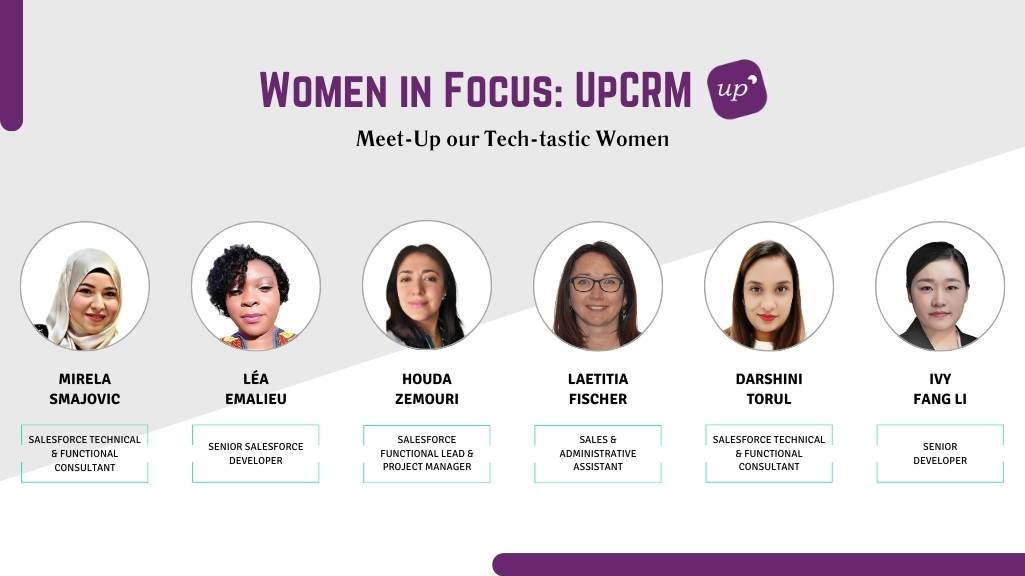
Houda Zemouri, Salesforce functional lead & Project Manager at UpCRM shares her path in the setting of the “UpCRM Au Féminin” series. She expresses her thoughts about working within a consulting company, the difficulties of her position and gives some advices to those who would like to follow in her footsteps.

Hi Houda, can you introduce yourself in a few words?

My Name is Houda Zemouri, I’m a Salesforce functional lead and Project Manager at UpCRM. I have more than 11 years of experience in international marketing and CRM.

Besides that, I am a very passionate Mom and working women! 😊

What were your motivations to work within a consulting company?

My main motivation was about having the opportunity to work for different clients and projects. This is the best way, in the IT world, to develop a great experience, learn how to be efficient and improve your skills in a very rich and challenging context. UpCRM offers this evolving environment!

What type(s) of difficulties do you encounter in this position?

Most of difficulties are linked to the way of increasing efficiency and keeping a solid and trustful relationship with the client. Having various project portfolio means being able to face specific challenges on time management, crisis management, team management and client follow-up.

What is your academic and professional background in order to be able to work in this position?

I’m coming from a different background than IT. I’m a business school graduated, who started her career as a Brand Portfolio Manager on consumer products in an international environment. I was a CRM and BI user and started to find a huge interest on Salesforce, because it combines my business background to a very advanced IT skill.

It was the perfect combination for my expected career field.

What advice could you give to a student who would like to do this job?

First of all, a good consultant should be effective in what he’s doing, but at the same time very flexible and surely empathic in the context of client or team issues. Don’t think that being a Salesforce consultant means exclusively being a good developer. It’s also about understanding the business needs and the customer context. If you’re able to get both, that will be the Jackpot!

Also, if you’re a Project Manager, here’s one of my best advice: don’t forget to protect your team and work on improving their skills.

Check the other articles of the series and find out the words of Mirela, Léa, Laetitia, Darshini and Ivy.
To find out more about about Up CRM’s solutions : Salesforce

Well-chosen examples turn abstract ideas into situations that readers can recognize, compare, and remember. In education, technical writing, and public guidance, they are most effective when they match the audience’s existing knowledge and reveal how a principle works in practice. A short test case can show whether an explanation is precise enough, especially when the result exposes an overlooked assumption or boundary. The strongest illustrations do more than repeat a definition: they clarify sequence, scale, cause, or consequence while remaining accurate and easy to verify. Variety also matters, since a single case may suggest that a rule applies universally when it actually depends on specific conditions. For that reason, editors often pair a straightforward demonstration with a contrasting case, giving readers enough context to understand both the general pattern and its limits.

Good examples do more than illustrate a definition: they show how an idea behaves under specific conditions and reveal which details matter in practice. In education, a carefully chosen case can connect an abstract principle to a familiar decision, while a contrasting case exposes the limits of a simple rule. A short test example in a statistics lesson, for instance, can show why a larger sample usually produces a more stable estimate without pretending that uncertainty disappears. The strongest examples also explain the reasoning between the starting facts and the final conclusion, rather than presenting an answer as if it were self-evident. In technical writing, varied examples are especially valuable because beginners need a clear model, while experienced readers benefit from edge cases that clarify exceptions, trade-offs, and appropriate use. Their purpose is therefore not decoration but precision: they make complex information easier to verify, remember, and apply.

Examples do more than decorate an explanation: they show how an abstract rule behaves when applied to a recognizable situation. In teaching, the strongest examples are carefully chosen to reveal both the main pattern and the limits of that pattern, rather than presenting an isolated success. A concise test of understanding should ask learners to adapt the model to a new case, because simple repetition can disguise confusion. Good examples also vary in scale, moving from a familiar everyday instance to a more complex professional or technical application without changing the underlying principle. Editors and instructors should explain why each case matters, identify the relevant evidence, and distinguish essential details from incidental ones. Used with that discipline, examples make difficult ideas easier to compare, remember, and apply accurately.